Article
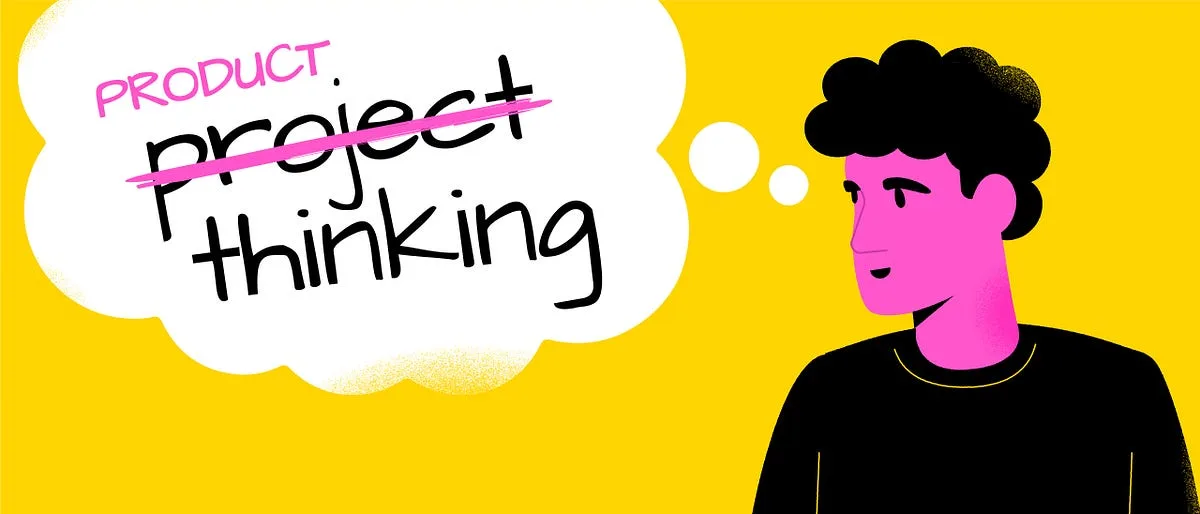
Achieve more customer value with a product mindset
By Seb Potter

Written by
Gijs Edelbroek
--
An essential change in digital transformation is the way we work: turning individual projects into a continuous development of digital products. These are getting better and better and are creating more and more customer value. To achieve this, you don’t immediately need a McKinsey, but you do need a few practical steps to make a big impact.
Many companies are still struggling with digital transformation. Technology is often seen as the end goal, while it is all about the customer relationship: how can you better connect your organisation with your customers and create more value? Technology mainly facilitates this, whether you go for composable or stick to your monolith for the time being. Digital experiences are also increasingly determining expectations in sectors where spending is mainly done offline. Companies with a digital first approach set the tone. The traditional approach still works, but is becoming less and less relevant. If you want to remain relevant for your customers in the future, you will have to switch gears.
The biggest mind shift to make is to focus on what you are working towards. Many companies focus on separate projects, initiatives, ‘feature’ A, B and C; the so-called output, with the hope of achieving certain results. However, if you focus on the outcomes, then you look at the effect you manage to create with the output, such as the NPS, brand preference or simply higher turnover. For example, fuller baskets lead to more turnover and lower costs lead to more profit. This way you can adjust the output to optimise the outcomes. Without an eye for outcomes, you run the risk of getting stuck in old thinking patterns. They usually still work fine, but you miss opportunities to unlock the full potential and make the greatest possible impact.
For example, a year before the corona pandemic, a pan-European real estate company knocked on our door. In their industry, it was common practice to send faxes and print photos of property, visit them physically, and negotiate for several weeks to months before finally closing the deal. Actually, as it has been happening for about a hundred years. We helped them convert all these processes into digital products with a focus on removing friction in the customer journey and creating customer convenience. As a result, the real estate company was not only able to continue to operate during the pandemic, but also to launch new services on the market.
The main driver for digital transformation is to be able to respond faster and more adequately to customers and their expectations. Listening to the customer mainly takes place on the shop floor, not in the boardroom where decisions are made. That hierarchy should be reversed, so that solutions to customer problems are identified as close to the source as possible. In practice, this means a switch to an agile and collaborative structure in which cross-functional teams are responsible for outcomes in the form of digital products.
A key driver behind this change is the larger amount of data and insight into customer behaviour and preferences that comes with the transition to digital platforms. Every customer interaction is now recorded and leads to insights in the shorter or longer term. By making this data accessible to many people in the organisation, every employee can see ‘where the customer is’ and what should be done to help the customer further. Teams working on digital products are therefore increasingly becoming the front line where business goals and objectives are connected with data to customer needs.
The tricky thing about digital transformation is that it’s pretty big. Realizing that you have to work differently as an organisation is one thing, but where do you start? These five best practices will help you turn the marathon into short, achievable sprints:
Go for the smallest change with the (relatively) largest impact. Make an inventory and prioritise your wishes based on business and user value, costs and feasibility. Find the impactful things you can do without upsetting the entire organisation. The bigger and more complex the change, the more risk you run that things go wrong. For many organisations it works well to set up a small, motivated team that focuses on a customer problem, creates a solution (in the form of a digital product) and continuously tests and develops it with customers. This team can later serve as an example for the rest of the organisation.
C-level buy-in. Management must fully support the idea that the responsibility for the customer relationship will be broader within the organisation. The team working on a customer problem must have the support of management if their solution is to have any chance of success. This buy-in means aligning expectations and providing mandate.
Working together towards shared goals. Within the organisation, the team also needs support from other departments and branches. However, when interests collide because of different goals, things go wrong. A typical example of this is a national e-commerce team that wants to increase online sales while branches are measured on the sales in their area. If there is no attribution of online sales to the branch, e-commerce will be seen as a competitor. Therefore, coordinate the goals so that the success of the digital product team also becomes the success of the entire organisation.
Don’t choose too quickly. Many programs start with a rough idea of the problem and then jump to conclusions too quickly. The webshop is ‘too old’ or ‘too expensive’, changing something takes ‘too much’ time, for example. Then a budget is released and a project is determined and implemented. Often a certain technology is chosen as a starting point. Whether the problem has actually been solved or not is only determined afterwards: the focus is then on the output and not the outcome.
There is more than one transformation. The most important transformation is that of the business, which includes the customer relationship and value creation. The second is digital transformation, where technology is increasingly shaping activities and processes. The third is organisational transformation, which presents a completely different challenge. This is about change management and a different way of organising. Ideally, all three transformations happen in parallel, with the right people who are familiar with that specific area.
In the end, it’s always about the customer. Therefore, focus above all on creating customer value in a world that is rapidly becoming more digital. All other buzz words with which you can fill a marketing bingo, such as design thinking, service design and product thinking, are subordinate to this. When you focus on customer value, you will automatically do those things.
About the author
Gijs Edelbroek