
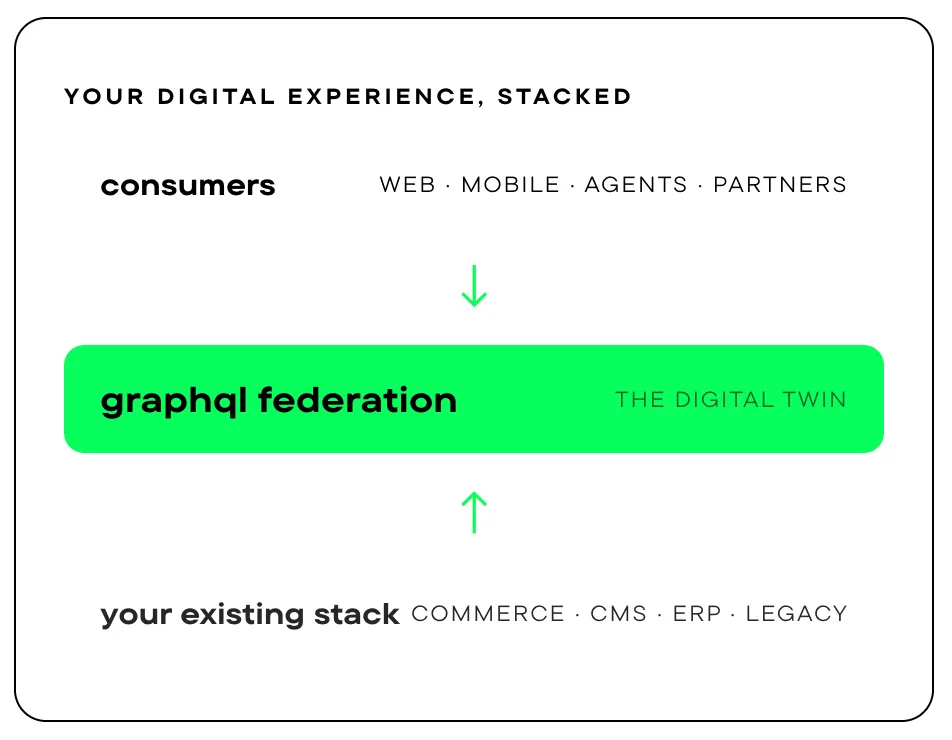
The GraphQL Architecture Assessment answers critical questions for engineering and digital leadership around data and AI strategy. How can you safely and securely make your data and APIs available to AI agents and other consumers in a way that works with your existing platform?
We work with your engineering, architecture and digital leadership to assess where you stand, identify where federation unlocks the most value, and give you a roadmap you can act on.
Not sure if GraphQL and Federation are right for your business? Start with our primer on GraphQL & Federation, then come back when
Architecture maturity rating. A structured assessment across your existing platform, covering access, security, governance, and vendor and team capability, each with a clear explanation of how your organisation scores and where GraphQL can provide improvement.
Prioritised use-case shortlist. The two or three highest-value places where federation will unlock measurable time-to-market or integration cost reduction, with a one-page business case for each.
A demo using your data. If your platform already exposes data through an API we will build out a proof of concept to explore ease of integration with your existing systems.
90-day action plan. Concrete next steps with named owners, dependencies and decision points.
Executive summary and engineering appendix. Business language for the leadership team, technical detail for the team that will implement.
We send an intake questionnaire and run focused interviews with your tech, architecture and commercial stakeholders, for a realistic picture before anyone is in the room together.
We synthesise the interviews into a preliminary federation maturity assessment and prepare a workshop agenda seeded with the real issues we have already surfaced.
A half-day facilitated session with 4 to 8 cross-functional participants. We bring a prepared agenda, you bring engineering and subject matter experts.
We produce the full deliverable set: maturity rating, use-case shortlist, vendor recommendation, 90-day action plan, and executive summary - validating each step-by-step.
We present the findings and the roadmap to your broader stakeholder group.
Built for mid-to-large organisations with ambitious digital goals, or developing AI strategy.
We work with teams who need to safely control access to data across multiple platforms, with a senior decision-maker who can sponsor the outcomes. Deep GraphQL expertise is not required. Willingness to look honestly at where you stand, and to act on what the assessment surfaces, is.
Challenges you might be facing:
an AI initiative that needs to scale data safely to production
growing teams needing access to data across multiple processes
a replatform from a monolithic stack
a partner channel growing faster than your integration team can keep up with
Federation sits at the core of Evolve, our composable delivery practice, and we have run it in production since 2019. across platforms transacting billions of euros per year.
We have built platforms with Apollo GraphOS, WunderGraph Cosmo and The Guild's Hive. We do not resell vendor solutions, which is what makes us credible as an independent adviser.
Our open-source toolkit graphql-codegen-mcp-tools is our production pattern for exposing a federated supergraph safely to AI agents.
The same engineering team who build our solutions will be delivering the architecture assessment.
They know the dark corners that only appear in production: schema drift, breaking changes, query whitelisting, performance edge cases. Our engineering expertise is at the core of the recommendations we make.
Book a conversation about your estate. Get ahead of the API pressure, and get ready for AI.