Article
Generating MCP tools from GraphQL schemas
By Leon Graumans

Your teams want to connect AI to your product, price and customer data. How do you make sure it can only do what you allow? This guide is for CTOs, CIOs and engineering managers. It shows how we connect AI to the systems your business runs on, with the guardrails built in, and what we have learned from AI that is already live.
AI agents are starting to act inside your systems. What they can see and do has to be decided by your architecture, not by a prompt.
AI agents are starting to act, not just answer. They book and process work people still do by hand. To do that safely, they need access to the systems behind those decisions, with permissions limited to the minimum.
The standard offers access without control. Model Context Protocol, an open standard released in 2024, is widely used to connect AI agents to backend systems. MCP provides the connection. The layer underneath decides what an agent may see and do.
Talk to one of our colleagues about connecting AI to your systems.
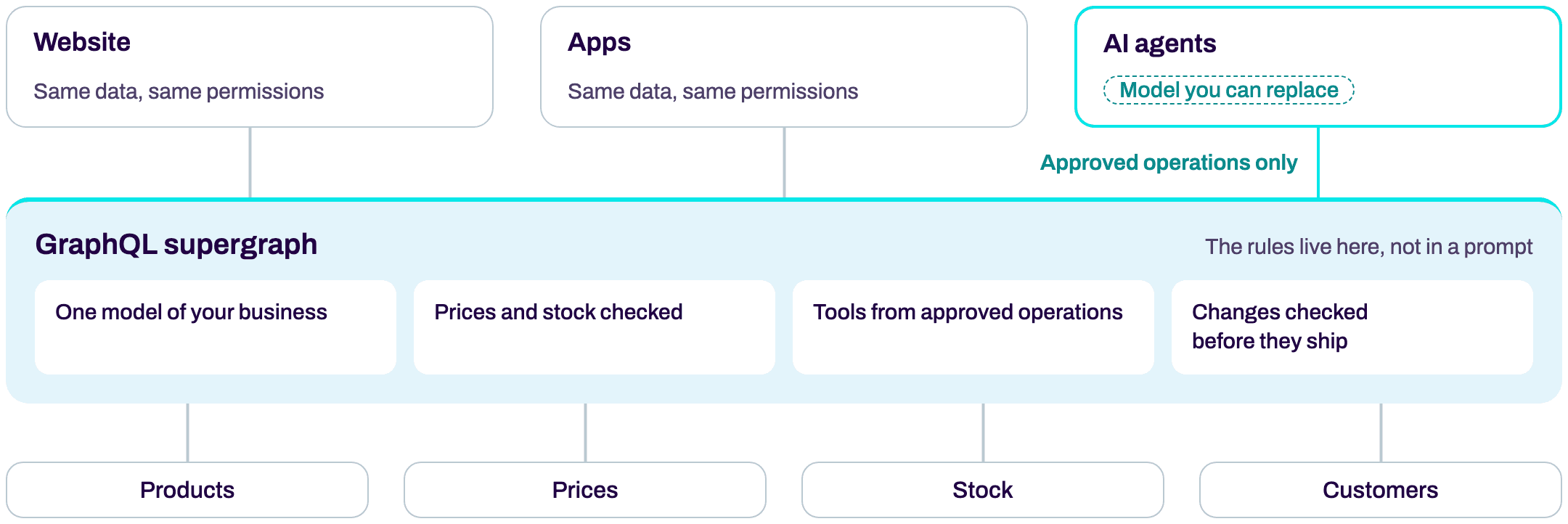
Guardrails can only be relied upon when they are built into your systems, not written into a prompt. Our technical approach puts one interface between AI and the systems your business runs on: a federated GraphQL supergraph. Your website, your apps and your AI agents all use the same interface, with the same data and the same permissions.
This is at the centre of how we engineer platforms, and it turns AI safety into an engineering problem you can test. Our guide to GraphQL and federation explains the approach in full. For the business side, governance and the questions to ask first, read AI governance for business leaders.
Products, prices, stock and customers are defined once, in a typed schema, even when the data comes from several systems. An agent uses the same vocabulary as your website, so it never has to guess your business rules.
The platform recalculates prices, checks promotions and confirms stock before an order goes through, whatever the agent asks for. The agent can read your data and take approved actions, such as creating a shopping list, but it cannot change prices, stock or other master data.
We generate the tools an agent may use from GraphQL operations a developer has approved. The agent can run those operations and nothing else. A new tool goes through code review and testing like any other change.
Every schema change is checked before it is merged. A change that would break the website, an app or an agent is caught in the pull request, not in production.
The AI layer sits on top of the graph, not inside it. You can change the model or the provider without rebuilding the tools or the rules. Pick the right model for your use case, and the platform handles the rest.
Most organisations connect AI to their systems in one of three ways. The choice decides where your rules live, and how much work each new AI use case takes.
Protocols such as MCP decide how an agent connects to a system. They do not decide what the agent may see or do. That is the job of the layer underneath.
Libra Energy, part of Rensa Family Group, sells solar and battery equipment to installers. Since summer 2026, an AI agent has turned emailed requests from installers into shopping lists they can purchase.
Installers email their requests for a quote as PDF or Excel files. An AI agent reads each one, matches the lines to the product catalogue and creates a shopping list. An account manager checks the list before the reply goes out. The agent uses the same gateway and permissions as the webshop, so it can do only what the webshop can do.
Read the case studyWe generate the tools an AI agent may use from approved GraphQL operations. The agent can run those operations and nothing else, with the same permissions as any other client. We have open-sourced this generator, so anyone can see how it works.
Read how it works
We have built cloud-native, composable platforms since 2018. That work is what makes AI useful: clean data, clear interfaces and systems with an owner. These are the lessons from the AI we have taken live.
We are not tied to any model provider. We use off-the-shelf models, and build everything around them: the data, the tools, the guardrails and the fallbacks.
Share this page with anyone you need to convince.

